The Futenma-Henoko Stalemate and Okinawa’s Gubernatorial Election: Why Okinawa Must Look Beyond U.S. Hegemony
The people of Okinawa confront the unsettling prospect that the long-awaited closure and return of U.S. Marine Corps Futenma Air Station may never materialize. Technical issues have delayed construction of Futenma’s replacement facility at Henoko and have raised serious questions about the project's feasibility. The prospect that the U.S. military may use Henoko while Futenma remains operational has become more plausible. The Futenma-Henoko stalemate is a focal point of the September gubernatorial election. To resolve the stalemate and U.S. base issues, the people of Okinawa must recognize and leverage the vast geopolitical and economic shift from U.S.-dominated unipolarity to multipolarity. Our votes must reflect this crucial awareness.
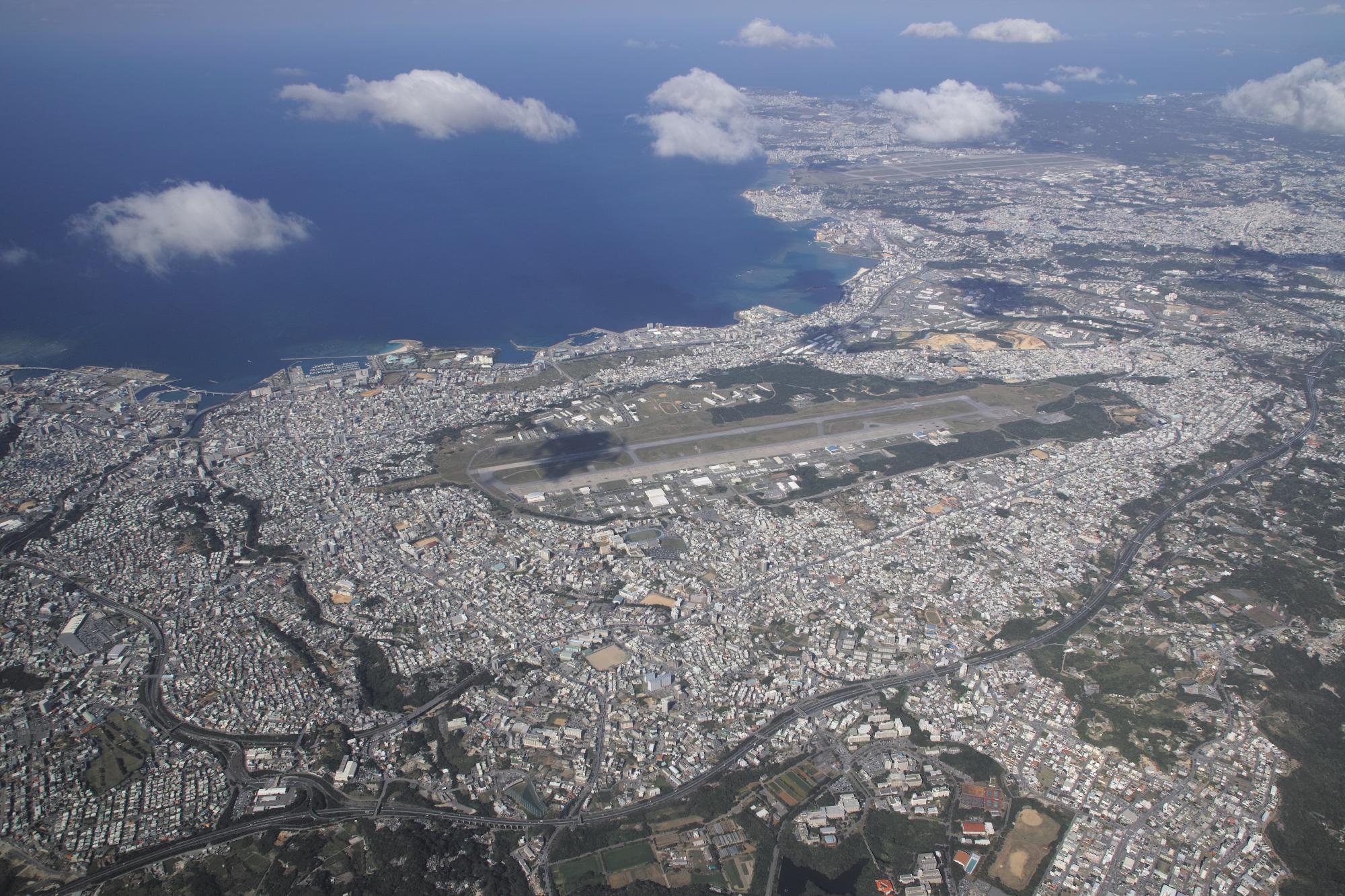 |
| Futenma Air Station in Ginowan City Image Source: Ginowan City |
 |
| Henoko-Oura Bay Construction Site Image Source: H. Y. |
For opponents of the Henoko base, this scenario is unacceptable, yet fears of its realization are growing. Meanwhile, supporters of the official U.S.-Japan stance that constructing the Henoko base is “the only solution” to eliminate the danger of Futenma look to the Tokyo government to dispel these concerns. As a result, a renewed collective demand for the immediate closure of Futenma has emerged even as deep political disagreements over the Henoko project remain.
The upcoming September gubernatorial election has made the Futenma-Henoko stalemate a focal point in Okinawan politics. The candidates’ election platforms reveal that Okinawa’s public discourse on the Futenma-Henoko issue has been and continues to be framed by the perception that U.S. military power remains an immutable reality. What the overarching framework of the discussions fails to account for is the vastly changing geopolitical and economic landscapes in East Asia and beyond; more precisely, a shift from a unipolar to multipolar order. The people of Okinawa must recognize and leverage this evolving global landscape in order to resolve this stalemate and find a meaningful path for Okinawa’s future.
Renewed public debate over the Futenma-Henoko issue was spurred by the publication of an article on February 15 by Sumiyo Heianna, a U.S.-based special correspondent for The Okinawa Times.(1) The article was based on an official U.S. military document released in September 2025, which stated the U.S. military’s position that the Futenma Air Station would not be returned upon the completion of the Henoko base alone. It stipulated that because the proposed runways at Henoko are too short for contingency operations, the Japanese government must secure an alternative airport with a runway of 2,700 meters or longer: “Pursuant to the terms of our arrangement, finalizing the selection of that alternative runway is the responsibility of the Government of Japan, and the Futenma facility will not be returned to Japan until it makes that selection.”

For the Okinawan public—who have long been subjected to the governments’ “Henoko is the only solution” narrative and thus have assumed that Henoko’s completion would automatically mean Futenma’s return—Heianna’s article was a revelation. Given that the feasibility of constructing Henoko had been seriously questioned due to the soft seafloor,(4) the article sparked deep concern that the U.S. military has no true intention of closing Futenma. Furthermore, the U.S. insistence that Tokyo secure a long-runway alternative fueled speculation that Naha Airport in Okinawa would be selected—an outcome that directly undermines Tokyo and Washington’s promise to reduce Okinawa’s military burden.
 |
| DoD document shown in Heianna's article Image Source: Okinawa Times |
Construction of New Offloading Fuel Facilities at Futenma Air Station
For many in Okinawa, this plan was viewed not as a routine operational update complying with the DoD’s “Antiterrorism Force Protection standards,” but as a sign that the U.S. military intends to operate Futenma for the foreseeable future.(9) This perception was further reinforced by its continued reliance on the Kuwae Tank Farm in Chatan—a facility originally scheduled for return to Okinawa in fiscal year 2022 or later under the 2013 Consolidation Plan.(10) To local observers, these documents serve as compelling evidence that key elements of the bilateral consolidation agreements will remain unfulfilled.
Legacy Facilities in Okinawa and Evolving Weaponry Systems in East Asia
Coincidentally, the DoD document serves as a stark reminder of how deeply militarization has penetrated Okinawa since World War II, as well as how limited public access to information about this infrastructure is. It also exposes that legacy U.S. military installations have become increasingly vulnerable amid contemporary East Asian security dynamics.
 |
| Exposed pipelines near Kurashiki Dam Image Source: HY |
These global strategic perspectives on Futenma, while discussed in the local media and academia, have not entered Okinawa’s public discourse on the Futenma-Henoko stalemate. Okinawa’s public discourse has remained narrowly focused on the island.
 |
| Team Ginowan Gathering Image Source: Ginowan City PR |
Demanding the Closure and Removal of Futenma: A New Unified Voice or Re-emerging Fractures and Constraints?
 |
| Denny Tamaki Image Source: Tamaki's Election Website |
 |
| Genta Kojya Image Source: Kojya's Election Website |
Many believe that whoever wins, the Futenma-Henoko stalemate will continue for an uncertain period, though election results will have differing implications. If Tamaki wins, the Japanese government’s political pressure will intensify. Maintaining that Henoko is the only solution, it will proceed with construction at Henoko, destroying the precious environment while allowing Futenma to remain operational. If Koja wins, the force of nature (the soft seafloor) will continue to hinder construction, eventually forcing the Japanese government to adopt a drastic change to the original Henoko plan while keeping Futenma open. This stalemate is likely to continue until the U.S. and Japanese governments begin discussing alternatives to Henoko and Futenma. The question is what would prompt the governments to do so, or what the people of Okinawa, especially politicians, need to do to enable them to do so.
Decades of intense political investment—both opposing and supporting the construction of the Henoko base and military bases in general—have created significant social and institutional inertia. For those who oppose it, the stalemate reflects the lopsided power relationship between Okinawa and the Tokyo and U.S. governments. For those who support it, this power relationship has generated economic benefits in land rent, construction, restaurants and bars, and development projects, alongside the immediate burdens of militarization. For both, the stalemate represents and reinforces their understanding that U.S. military power is an immutable reality. This inertia keeps candidates from addressing the geopolitical shift. Concerningly, the candidates’ platforms not only reflect their understanding of U.S. hegemony but could also perpetuate it, thereby hindering their ability to realize their ambitious policies.
Conclusion
International power structures are undergoing significant transformation. The rise of multipolar economic frameworks, such as BRICS, reflects shifting geopolitical realities, and neighbouring Asian and Pacific nations are actively, though cautiously, integrating these realities into their long-term planning.(23) Some regions of nations have also taken advantage of this transformation by engaging in subnational diplomacy.(24) These global shifts are creating unprecedented conditions for Okinawa too.
To resolve the enduring issues of Futenma and Henoko and to chart a sustainable path for future generations, Okinawan society and its political leadership must look beyond the military-dominated bilateral frameworks that have long constrained them. We need to recognize the evolving global geopolitical and economic dynamics. We need to articulate this recognition and leverage it with both the Japanese and U.S. governments as we pursue a meaningful path that anchors demilitarization and environmental restoration as a public undertaking. Only through such an endeavor can Okinawa strive to be a hub for the economy, tourism, technological innovation, cultural exchange, and peace in Asia, as it has always aspired to be.
###
https://www.okinawatimes.co.jp/articles/-/1775448
3. United States Government Accountability Office (2017). Marine Corps Asia Pacific Realignment: DoD Should Resolve Capability Deficiencies and Infrastructure Risks and Revise Cost Estimates.
https://www.gao.gov/assets/gao-17-415.pdf
4. “Okinawa Kenchijisen hikae Henoko shinchoku kyocho jittaiwa wazuka ichiwari no jiban kairyo owaranu nan kouji” [Ahead of the Okinawa gubernatorial election, Tokyo emphasizes “progress” at Henoko; in reality, only 10 percent of the ground improvement work has been completed, and the difficult construction project shows no signs of ending]. The Okinawa Times. July 17, 2026.
https://www.jiji.com/jc/article?k=2026021900256&g=int#goog_rewarded
6. “Futenma henkan sogo hitei Koizumi boueiso beigawa ninshiki ni hanron” [Defense Minister Koizumi denies “discrepancies” over return of Futenma and rebuts U.S. position]. Jiji Tsushin. February 20, 2026.
https://www.jiji.com/jc/article?k=2026022001106&g=pol
7. Heianna, Sumiyo. 2026. “Futenma ni rokujyuichi okuen no shinnenryoshisetsu kokubousoushouga setsubikeikaku henkangomo shiyou shiyaka” [The DoD plans to build a new 6.1 billion yen fuel facility at Futenma: Is Futenma's operation under consideration after its return?]. The Okinawa Times. July 20, 2026.
https://www.okinawatimes.co.jp/articles/-/1884105https://www.mod.go.jp/j/approach/zaibeigun/saco/pdf/20130405_okicon_plan_e.pdf
https://www.pref.okinawa.lg.jp/_res/projects/default_project/_page_/001/004/872/fac6076_r080317.pdf
13. Ministry of Defense. 2026. 2026 Defense of Japan Pamphlet.
https://www.mod.go.jp/j/press/wp/wp2026/pdf/R08zenpen.pdf
U.S. Department of War. 2026. 2026 National Defense Strategy.
https://media.defense.gov/2026/Jan/23/2003864773/-1/-1/0/2026-NATIONAL-DEFENSE-STRATEGY.PDF
14. Funaiole, Matthew P. and Hart, Brian. 2025. “China’s Military in 10 Charts.” Center for Strategic and International Studies. September 25, 2025.
https://www.csis.org/analysis/chinas-military-10-charts
15. See Cancian, Mark F., Matthew Cancian, and Eric Heginbotham. 2023. The First Battle of the Next War: Wargaming a Chinese Invasion of Taiwan. Center for Strategic and International Studies.
https://www.csis.org/analysis/first-battle-next-war-wargaming-chinese-invasion-taiwan
https://news.yahoo.co.jp/articles/1cdaa564a0d0d8f2b0f3b31dbc1df66bb3b3ff85
https://news.yahoo.co.jp/articles/4aa90d1ee8b98952fe9bd1486ff33f3296efac3b
18. “Sakimashicho ‘daitaishisetsu wo hayaku kensetsu surukotoga jyuyo’ chimu Ginowan no shushi wo itsudatu shita yousei Tamakichiji rani” [Mayor Sakima emphasizes to Governor Tamaki and others the importance of early construction of the “replacement facility”: his request deviates from the purpose of Team Ginowan]. The Okinawa Times. July 29, 2026.
19. “’Chimu Ginowan” Sakimashshicho ni Henokoisetuhantai shimin ga shitsumonjyo seimeininai ‘Henoko younin’ ni fumikonda yousei ni kikikan” [Civic members of “Team Ginowan,” who oppose the Henoko relocation, submit a letter of inquiry to Mayor Sakima: Members express a sense of crisis about Sakima’s request because the adopted Statement does not state that Team Ginowan accepts the Henoko plan]. Ryukyu Broadcasting Corporation (via Yahoo News) July 30, 2026.
https://newsdig.tbs.co.jp/articles/-/2839389
20. For discussion on China’s military capabilities in East Asia, see Eric Heginbotham, Michael Nixon, Forrest E. Morgan, Jacob L. Heim, Jeff Hagen, Sheng Tao Li, Jeffrey Engstrom, Martin C. Libicki, Paul DeLuca, David A. Shlapak, et al. 2015. The U.S.-China Military Scorecard: Forces, Geography, and the Evolving Balance of Power, 1996–2017. Rand Corporation.
https://www.rand.org/pubs/research_reports/RR392.html
See also Cancian, Mark F., Matthew Cancian, and Eric Heginbotham. 2023. The First Battle of the Next War: Wargaming a Chinese Invasion of Taiwan. Center for Strategic and International Studies.
https://www.csis.org/analysis/first-battle-next-war-wargaming-chinese-invasion-taiwan
21. For discussion among the gubernatorial election candidates, Denny Tamaki, Genta Kojya, and Mikio Shimoji, who withdrew from the race, see this clip. The Okinawa Times. July 29, 2026.
https://www.youtube.com/watch?v=2JvfalOLIAY
Also see this clip. The Ryukyu Shimpo. July 17, 2026.
22. Okinawa Prefectural Government. 2024. “Basic Policy for Subnational Diplomacy of Okinawa Prefectural Government.”
https://www.pref.okinawa.lg.jp/_res/projects/default_project/_page_/001/017/561/gaikouhousin.eng.pdf
See also Sasaki, Rena. 2026. “Weaponized paradiplomacy in and around Taiwan: subnational engagement as strategic tool in Sino-Japanese competition.” The Pacific Review.
https://doi.org/10.1080/09512748.2025.2589168
23. See, for example, Ngamyingsanga, Bhumpat. 2026. “Southeast Asia Global Relations Outlook Part 2: U.S. and China.” Southeast Asia Public Policy Institute. January 07, 2026.
https://seapublicpolicy.org/part-ii-asean-and-global-horizons/
Also see Suri, Moksh and Sharma, Abhishek. 2023. “South Korea’s Economic Security Dilemma.” The Diplomat. January 25, 2023.
https://thediplomat.com/2023/01/south-koreas-economic-security-dilemma/
24. See, for example, Nandkumar, Karuna. 2025. “Diplomacy at the Periphery: How the PRC’s Border Provinces Shape Neighborhood Engagement.” Borderlands.
Also see Liu, Suejun and Thomas, Nicholas. 2026. “The Philippines subnational relations with China: from antechamber to equality?” Journal of Contemporary East Asia Studies.
https://doi.org/10.1080/24761028.2026.2657655


